
Criminal Court Records in Allegan County
A criminal court record is not the same as an arrest report. It is the case file the court opens when a prosecutor files charges. The file grows as the case moves along. Every hearing, motion, plea, and order gets added to it. When the case ends, the record shows the disposition and, if there was a conviction, the sentence. This is the document people mean when they ask for someone's court history rather than a booking sheet.
Two trial courts produce these records in Allegan County. All adult criminal cases start in the 57th District Court, no matter how serious the offense. That court handles misdemeanor cases through to sentencing, and it holds arraignments, sets bail, and conducts preliminary examinations for felonies. When a felony is bound over, the case moves up to the 48th Judicial Circuit Court, the county's general-jurisdiction trial court. The circuit court records division, which works under County Clerk Bob Genetski, receives, processes, and preserves the felony case files. For a closer look at the charges themselves, see the Allegan County arrest and charge records page.
How to Search Allegan County Criminal Court Records
Most Allegan County criminal cases can be found through Michigan's statewide case search. The county's own district-court case-search link redirects to the same tool. It reaches district, circuit, and other MiCOURT courts, so a single name search can surface both the early district-court file and the circuit-court file after bindover.
- Open the Michigan MiCOURT case search and choose Allegan County and the correct court.
- Search by defendant name or, if you have it, by the case number.
- Narrow the results by court, case type, and filing date to find the right file.
- Open the case to read the docket, the charges, and the disposition.
- Ask the circuit court records division for a certified copy when you need one for legal use.
When the online result is thin or the file is too old to appear, the county's records-request route is the fallback. The 48th Circuit Court Records Division handles copies and name searches for circuit criminal files. Copies cost $1 per page, and certification on a final judgment adds $10. In-person requests are taken at the courthouse, and the 57th District Court answers questions about its own cases. If a court record is not a court file, such as a police report, a FOIA request goes to the sheriff instead. Broader guidance on every search channel lives on the Allegan County court records page.
Stages of an Allegan County Criminal Case
A criminal case moves through set stages, and each one leaves a mark in the record. Reading the docket in order shows how the case traveled from a filed charge to a final sentence. The Michigan path always begins in district court and, for felonies, continues in circuit court after a bindover.
Case flow: Charges Filed › Arraignment › Preliminary Exam / Pretrial › Plea or Trial › Disposition › Sentencing
| Stage | What Happens |
|---|---|
| Charges Filed | The prosecutor files a complaint in the 57th District Court, which opens the case and assigns a case number. |
| Arraignment | The court reads the charges, sets or reviews bail, and takes the defendant's first plea. |
| Preliminary Exam / Pretrial | For a felony, a preliminary exam decides whether the case is bound over to circuit court. Misdemeanor cases move to pretrial. |
| Plea or Trial | The defendant pleads, or the case goes to trial before a judge or jury. |
| Disposition | The record shows the outcome: a plea, a verdict, a dismissal, or a bindover to circuit court. |
| Sentencing | After a conviction, the judge imposes jail, probation, fines, restitution, or a mix of these. |
Felony cases show two threads in the record. The early thread is the district-court file, where the arraignment and preliminary exam sit. The later thread is the circuit-court file, opened after bindover, where the plea or trial and sentencing take place. Misdemeanor cases stay in district court from start to finish.
What an Allegan County Criminal Court Record Shows
Michigan defines court records broadly. The Michigan Court Rules describe them as recorded information created by the court or filed with it, including pleadings, orders, judgments, and data entered into the case-management system. A public criminal case usually shows a case number, the party names, hearing dates and times, the courtroom, the judge or magistrate, and a status. One district-court case number seen in the county's own results read like 2026-0000072180-DC, where the DC suffix marks a district-court case.
| Field | What It Shows |
|---|---|
| Case Number | The court's file identifier, often with a year prefix and a court-type suffix. |
| Defendant | The person charged in the case, listed by name. |
| Charges | The offenses filed, with statute or violation text and severity level. |
| Plea | How the defendant answered the charge, such as guilty, not guilty, or no contest. |
| Disposition | The final outcome of each charge, such as convicted, dismissed, or bound over. |
| Sentence | The penalty imposed after a conviction, including jail, probation, fines, or restitution. |
The file also carries hearing notices, bond and payment status, and the attorney of record. Not every detail is open. Michigan Court Rule 8.119 requires courts to redact protected personal identifying information, such as Social Security and financial account numbers, before a record is shown to the public.
Charges vs. Convictions
Being charged is not the same as being convicted. A charge is an accusation. A conviction is a finding of guilt by plea or verdict. A criminal court record can list charges that were later reduced, dropped, dismissed, or that ended in an acquittal. Reading only the charge and stopping there gives a false picture of the case.
| Charge | Conviction | |
|---|---|---|
| Stage | Accusation at the start of a case | Verdict or accepted plea |
| Burden of Proof | Probable cause | Beyond a reasonable doubt |
| Can It Change? | Yes, it may be amended, reduced, or dropped | Stands unless set aside or reversed |
| Public Record | Yes | Yes |
The disposition field is where the difference shows. A charge with a disposition of dismissed did not end in a conviction. A charge with a disposition of guilty or convicted did. When a felony charge is bound over and later pleaded down, the circuit-court file shows the charge the defendant was actually convicted of, which may differ from the one first filed.
Reading Dispositions and Sentences
The disposition is the case outcome. Common terms appear again and again across Allegan County files, and knowing them makes the record easy to follow. A short glossary covers most of what a reader meets in a criminal docket.
- Disposed
- The case has reached an outcome and is closed.
- Dismissed
- A charge ended without a conviction; with prejudice it cannot be refiled, without prejudice it can.
- No contest (nolo)
- The defendant does not admit guilt but accepts the conviction.
- Bound over
- A felony was sent up from district court to circuit court for trial.
- Sentenced
- The court has imposed a penalty after a conviction.
The sentence sits at the end of the record. It can be jail time, probation, fines, court costs, or restitution paid to a victim. Circuit-court criminal cases also carry assessments, and the county collects payments on those through the court. Probation terms and orders are filed with the case, so the record shows both the penalty and the conditions attached to it.
Sealed vs. Expunged Criminal Records
People often confuse sealing and expungement, but Michigan treats them differently. A sealed record is hidden from public view by a court order under Michigan Court Rule 8.119 and stays sealed until a court unseals it. An expunged, or set-aside, conviction is treated as though it never happened for most purposes, and the public version of the file must have the set-aside information redacted.
The starting point for wiping a conviction is a set-aside application. The state statute that governs who may apply and how is shown below.
The application rules under Michigan set-aside statute MCL 780.621 spell out which convictions are eligible and how a person asks the convicting court to erase them.
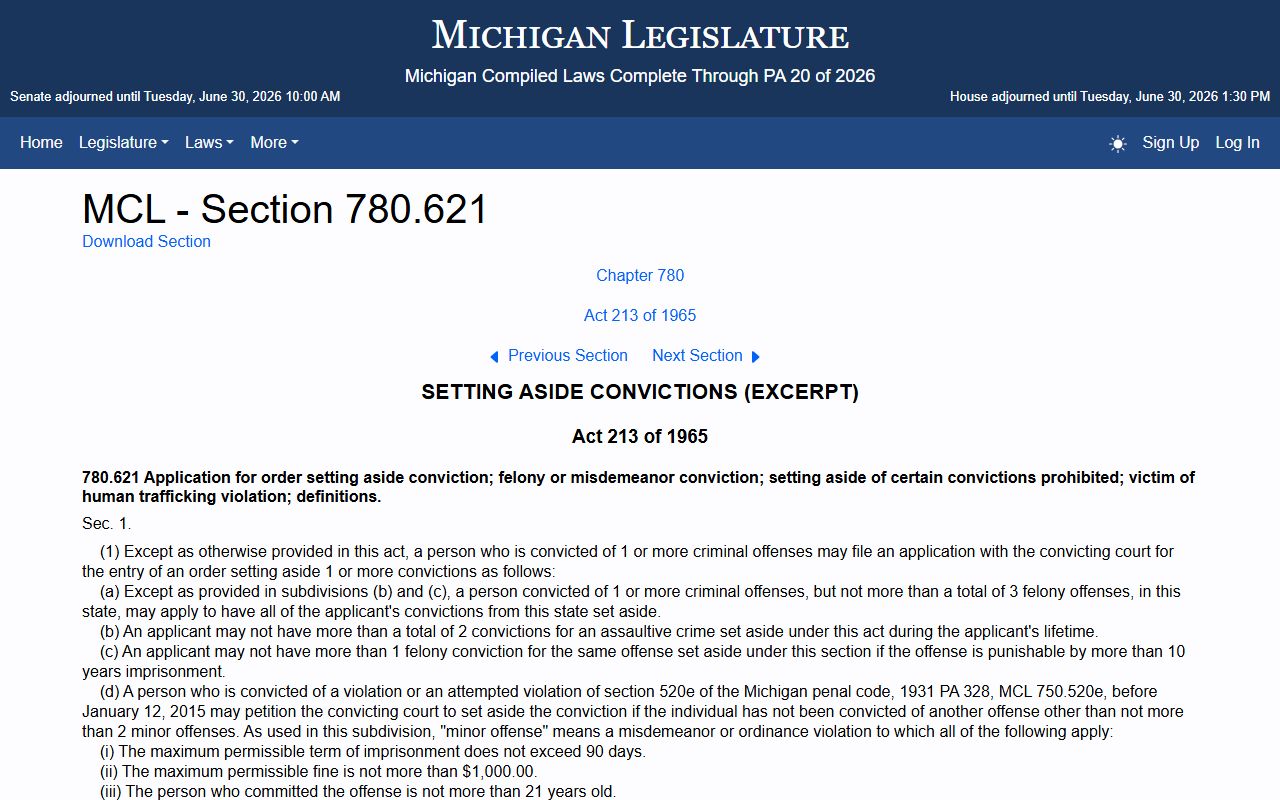
Once a conviction is set aside, it drops out of the public criminal court record and should not surface in a routine name search. The 57th District Court even keeps a resource link for questions about Michigan's Clean Slate conviction set-asides, which points residents toward help with the process.
| Sealed | Expunged / Set-Aside | |
|---|---|---|
| Visibility | Hidden from public view | Treated as if it never occurred |
| Law Enforcement | Limited access by court order | Very limited, kept in a nonpublic file |
| Governing Law | MCR 8.119 | MCL 780.621 and MCL 780.623 |
| Eligibility | Set by court order in the specific case | Eligible convictions under Michigan set-aside law |
The set-aside process runs through the court that entered the conviction. The steps below track how a Michigan application moves from filing to a granted order.
- Confirm the conviction is eligible under Michigan's set-aside law.
- File the application in the convicting court.
- Pay the required fee, or seek fee-related relief if it is available.
- Serve notice on the prosecutor and any required state agencies.
- Attend the hearing if the court sets one.
- If the court grants the order, the conviction becomes a set-aside conviction and public records are redacted.
- The public version of the case should no longer expose the set-aside charge in the same way.
Note: Michigan's Clean Slate rules also set aside some convictions automatically, but the safest path is to confirm status with the convicting court rather than assume a record cleared itself.
Public Access to Allegan County Criminal Records
Michigan keeps most criminal case files open. Access to court records is governed by court rules, while records held by county offices that are not court files fall under the Freedom of Information Act. For a criminal case, that means the docket, the charges, and the disposition are generally public, subject to the redaction rules. The statute that limits access once a conviction is set aside is shown next.
The access rules under Michigan set-aside effect statute MCL 780.623 describe how a set-aside conviction is shielded from the public while staying available to certain agencies.
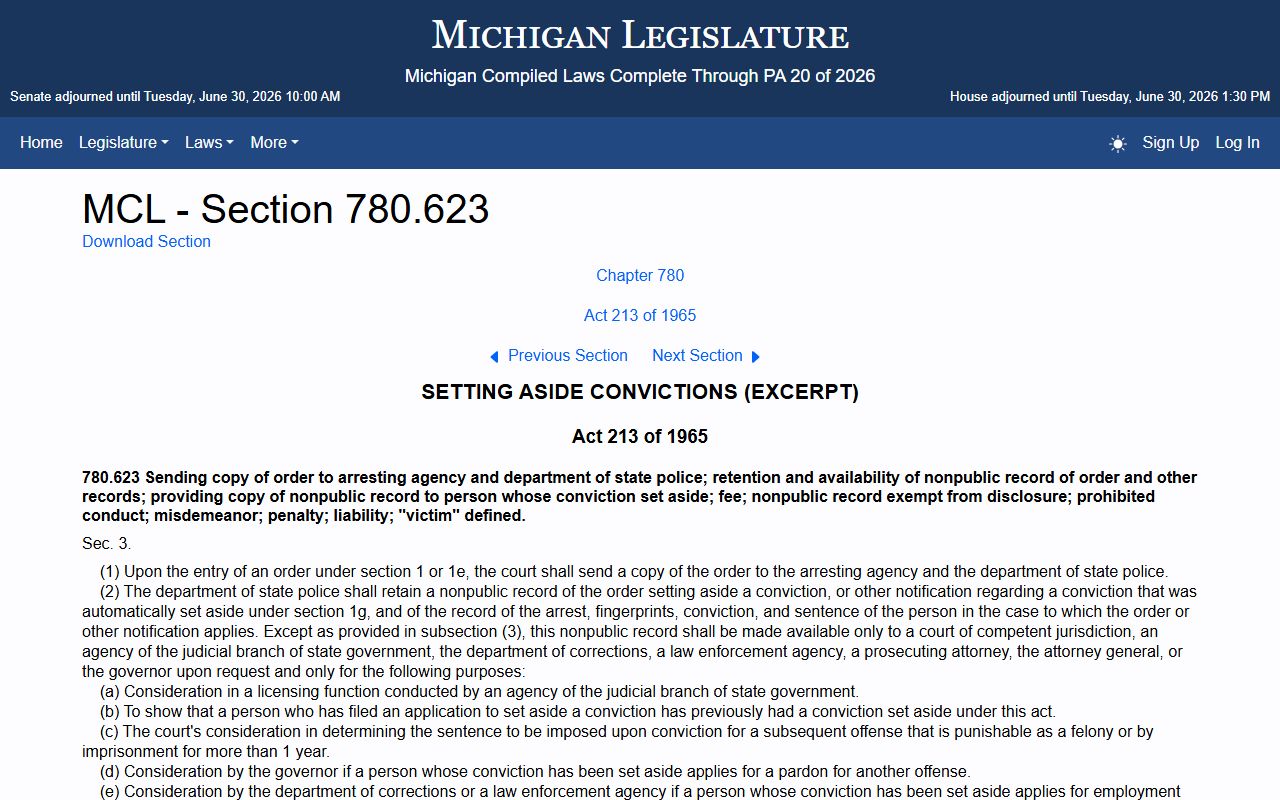
The rules balance open access against privacy. A few statutes and court rules do the heavy lifting for criminal files in the county.
Key Statutes:
Michigan FOIA MCL 15.233 gives a person the right to inspect, copy, or receive public records unless a specific exemption applies.
Michigan juvenile records statute MCL 712A.28 keeps juvenile case records with the court and open only by court order.
Background Check Considerations
A casual name search is not the same as a formal background check. A public case lookup can miss a sealed file, a set-aside conviction, or a charge that was later amended. It can also mix up people with similar names. For hiring, housing, or credit decisions, a regulated background check run under the federal Fair Credit Reporting Act is the correct route, because it carries accuracy and dispute protections that a quick search does not.
Important: This website is not a consumer reporting agency under the FCRA, and its information may not be used to decide credit, employment, housing, or insurance.
Restricted Criminal Court Records in Allegan County
Some criminal court records are not open to the public at all. Juvenile delinquency and protective matters run through the county's family court, and Michigan law keeps many of those files limited. Records sealed by court order stay closed until a judge unseals them, and set-aside convictions are redacted from the public file.
Other limits apply to specific documents. Protected personal information such as Social Security numbers and financial account numbers is redacted from public files. Ongoing investigations, mental health proceedings handled through probate, and certain family matters carry their own access rules. When a record sits behind one of these limits, the court or the office that holds it decides what can be released. Active warrants tied to a case are tracked separately from the case file itself.
Note: There is no county rule that opens a juvenile file automatically at age 18, so access stays controlled by statute and court order rather than by a person's age.